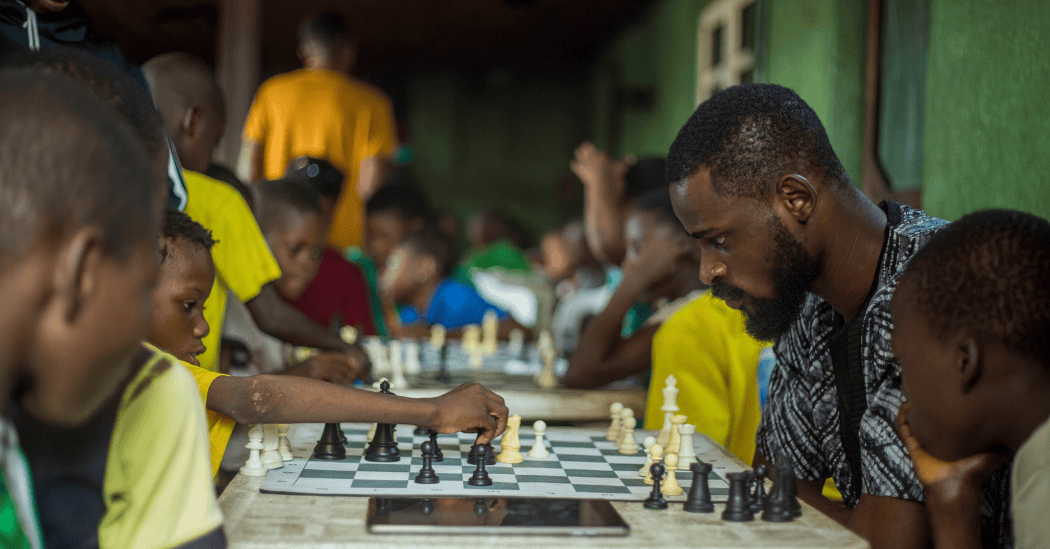
Founded in 2018 by Nigerian chess master Tunde Onakoya, Chess in Slums Africa began with a simple idea: chess could become a pathway to learning and opportunity for children growing up in underserved communities.
Onakoya understood those barriers personally. His experience growing up in Lagos helped shape an organization that uses the chessboard as an entry point for developing critical thinking, confidence, discipline, and problem-solving skills.
Today, that model has expanded considerably.
Chess in Slums Africa, or CISA, now combines chess with STEM education, digital literacy, socio-emotional development, scholarships, vocational training, and mentorship. The organization says its broader mission is to educate and empower one million children in marginalized communities across Africa over the next decade.
From Chess Lessons to an Education Platform
CISA’s work began by teaching chess to children in communities where educational opportunities were often limited.
The organization has since developed what it calls the C.A.S.T.L.E. framework. Its programs combine chess and character development with STEAM and digital skills, as well as education and empowerment initiatives that include literacy, mathematics, civic education, and mentorship.
Chess remains central to the model.
Learning to anticipate an opponent’s moves requires patience, strategic thinking, concentration, and decision-making. CISA uses those same skills to help children develop confidence in their ability to solve problems beyond the chessboard.
But the organization’s approach increasingly recognizes that developing those skills alone cannot address every barrier a child faces.
CISA now provides academic scholarships designed to help children enter and remain in formal education. Its programs also include vocational opportunities and digital skills training, while other initiatives have addressed access to healthcare for children and families.
Creating New Pathways for Girls
One of the clearest examples of how that model has evolved is CISA’s Queens Not Pawns project in Obanliku, Cross River State.
The initiative works with girls affected by the legacy of the “money wife” practice, under which girls and women were historically subjected to forced arrangements connected to debt or payment.
CISA says it began developing the project in 2022 after Onakoya learned about the experiences of women and girls affected by the practice. The organization conducted research and worked with community leaders before launching an intervention focused on survivors and daughters of survivors.
More than 50 girls participated in an intensive program combining chess with coding, computer literacy, and drone technology. The initiative was designed around education and empowerment while introducing participants to skills and possibilities they may otherwise have had limited opportunities to explore.
That work illustrates an important evolution in CISA’s approach. Chess can open the door, while education, technology, mentorship, and sustained support can create pathways beyond it.
From Lagos Communities to a Broader African Network
CISA has also expanded geographically.
Its work has reached communities across Nigeria including Makoko, Oshodi, Ibadan, Obanliku, Maiduguri, Lekki, and Majidun. Through a partnership with The Gift of Chess, more than 50,000 chess sets have also been distributed across 25 African countries to schools, orphanages, prisons, and community centers, according to the organization.
Its partnerships have helped extend the model further. Chess.com and ChessKid became content partners, providing access to chess education resources and helping connect the organization’s community work to the broader global chess ecosystem.
Individual outcomes provide another measure of what those opportunities can mean.
UNESCO recently highlighted children from Makoko who participated in Chess in Slums Africa programs as part of its #BornToLearn campaign. Among them was Blessing, who returned to learning through chess, became part of a leading Nigerian junior chess team, and earned a scholarship after placing third in a 2022 Children’s Day tournament.
Building Beyond the Chessboard
The evolution of Chess in Slums Africa reflects a broader understanding of educational access.
For children facing poverty and limited access to formal schooling, opportunity can require more than placing them in a classroom. It can involve building confidence, providing mentorship, addressing financial barriers, developing practical skills, and creating environments where children can begin to see different possibilities for themselves.
Chess gives CISA a way to begin that process.
The organization’s challenge as it grows will be translating a community-based model into sustainable, long-term educational outcomes across a much larger population.
Its ambition is substantial: reaching one million children across Africa over the next decade.
For the children already participating, however, the premise remains much simpler. A chessboard provides 64 squares and a finite set of pieces. Learning what is possible with them can become an introduction to thinking more broadly about what is possible beyond them.